CVPR 2026

wrivinder: Towards Spatial Intelligence for Geo-locating Ground Images onto Satellite Imagery

Chandrakanth Gudavalli1, Tajuddin Manhar Mohammed1, Abhay Yadav2, Ananth Vishnu Bhaskar1, Hardik Prajapati1, Cheng Peng2, Rama Chellappa2, Shivkumar Chandrasekaran1,3, B. S. Manjunath1,3
1Mayachitra, Inc. 2Johns Hopkins University 3University of California Santa Barbara
πŸ”’
Code & Dataset β€” Coming Soon. We are actively working to release the Wrivinder codebase and the MC-Sat dataset. The release is currently going through an internal approval process and we are resolving licensing issues to make everything available under a permissive, license-free terms. We will update this page as soon as it is ready.

Video Overview

Overview of the satellite-to-ground image alignment pipeline

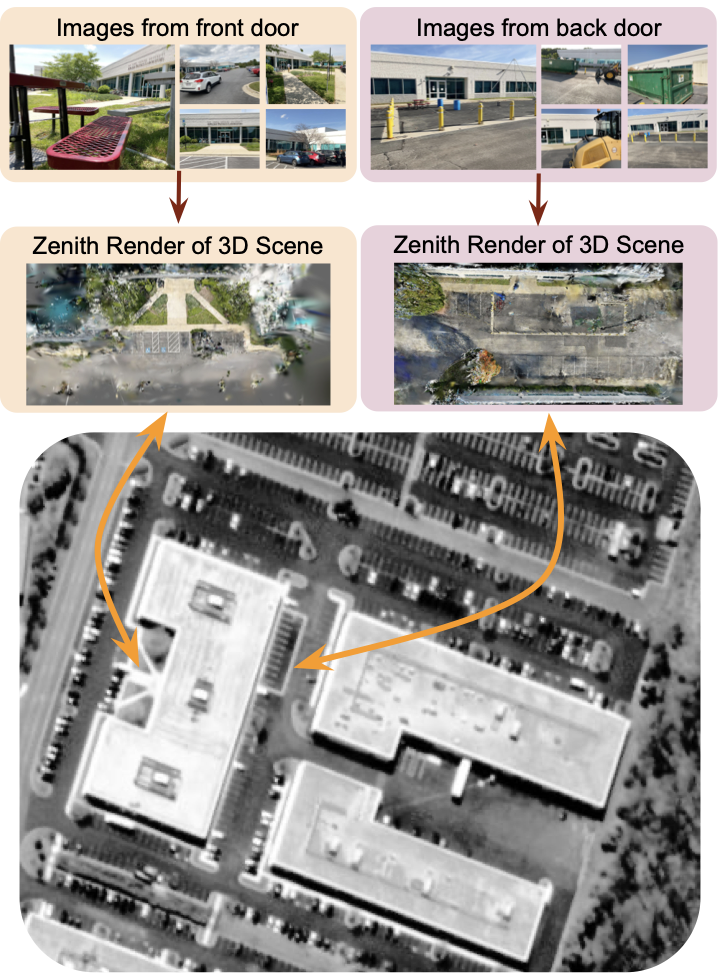
Overview of the pipeline. Directly aligning ground images to satellite views is impractical due to large viewpoint and scale differences. Wrivinder aggregates information from multiple ground images to reconstruct a 3D scene, generates a zenith-view rendering, and aligns it to the satellite image using estimated metric dimensions.
Abstract

Aligning ground-level imagery with geo-registered satellite maps is crucial for mapping, navigation, and situational awareness, yet remains challenging under large viewpoint gaps or when GPS is unreliable. We introduce Wrivinder, a zero-shot, geometry-driven framework that aggregates multiple ground photographs to reconstruct a consistent 3D scene and align it with overhead satellite imagery. Wrivinder combines SfM reconstruction, 3D Gaussian Splatting, semantic grounding, and monocular depth–based metric cues to produce a stable zenith-view rendering that can be directly matched to satellite context for metrically accurate camera geo-localization. To support systematic evaluation of this taskβ€”which lacks suitable benchmarksβ€”we also release MC-Sat, a curated dataset linking multi-view ground imagery with geo-registered satellite tiles across diverse outdoor environments. Together, Wrivinder and MC-Sat provide a first comprehensive baseline and testbed for studying geometry-centered cross-view alignment without paired supervision. In zero-shot experiments, Wrivinder achieves sub-30 m geolocation accuracy across both dense and large-area scenes, highlighting the promise of geometry-based aggregation for robust ground-to-satellite localization.

Contributions

MC-Sat Dataset

The first dataset linking multi-view ground imagery, SfM/3DGS reconstructions, and geo-registered satellite context across diverse outdoor environmentsβ€”15 scenes, ~20K ground images paired with NAIP and ESRI aerial tiles.

Wrivinder Framework

A geometry-driven, zero-shot framework that reconstructs a consistent 3D scene from multiple ground images and aligns it with overhead satellite imagery. Integrates SfM, 3DGS, semantic grounding, and metric depth cuesβ€”no paired supervision required.

Self-Supervised DTM

A lightweight, test-time self-supervised Deep Template Matcher (DTM) that aligns zenith-view 3DGS renderings to satellite images, enabling robust cross-view correspondence under extreme viewpoint changes without ground–satellite training pairs.

Method

Wrivinder uses geometry as the bridge between drastically different viewpoints. Instead of learning cross-domain correspondences from paired data, it reconstructs a 3D representation of the scene and aligns it directly to the satellite frame through geometric projection and self-supervised matching.

πŸ—ΊοΈ
SfM Reconstruction
HLOC + COLMAP / GLOMAP estimate camera poses & a sparse 3D point cloud.
✨
3D Gaussian Splatting
Octree-GS densifies the scene into a high-fidelity photorealistic model.
⬆️
Zenith Viewpoint
Semantic segmentation + PCA estimates the vertical axis for a top-down render.
πŸ“
Metric Mapper
Monocular depth (DepthPro / PatchFusion) + RANSAC recovers physical scale in meters.
πŸ”
Deep Template Matcher
Self-supervised Siamese ResNet-18 localizes the zenith render on the satellite tile.
πŸ“
Camera Geolocator
Back-projection through 3DGS + RANSAC similarity transform yields GPS for all cameras.
Wrivinder pipeline overview

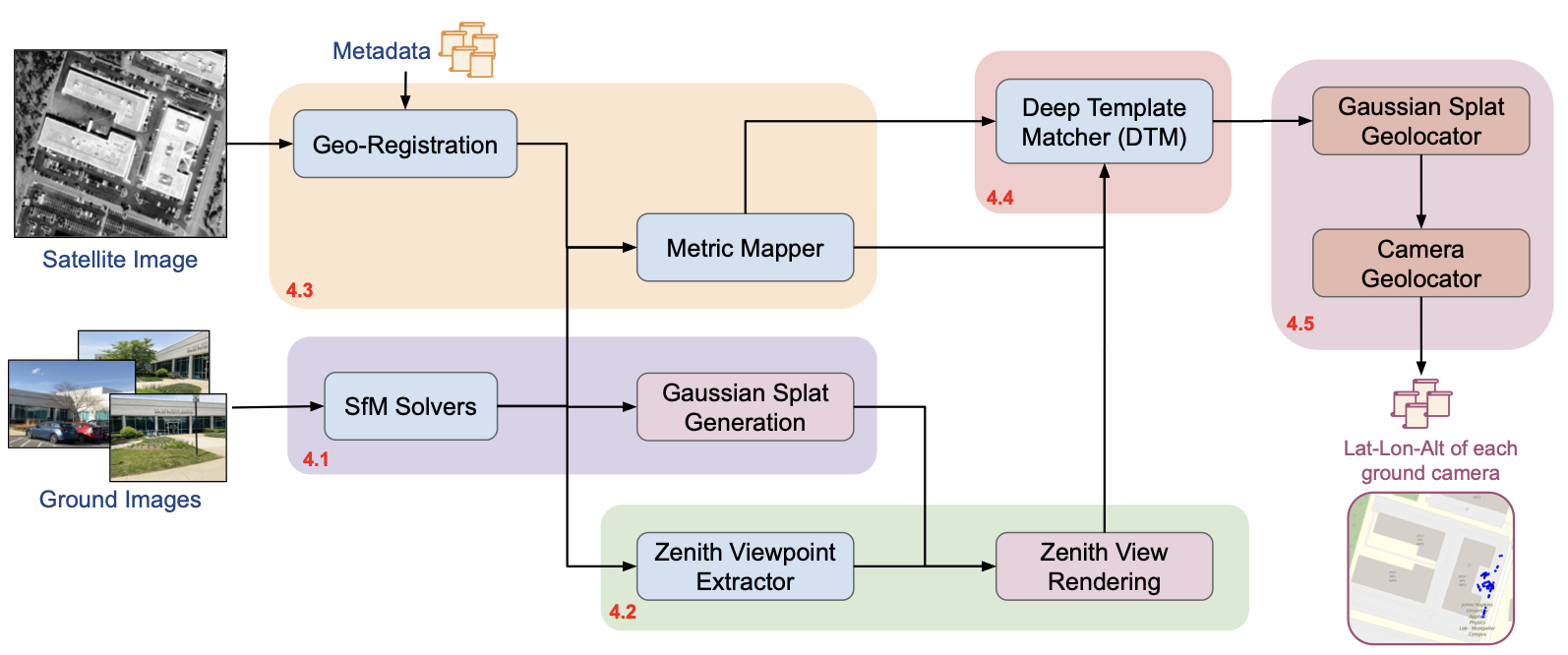
Wrivinder pipeline. Given an unordered set of ground images, the pipeline reconstructs a sparse 3D scene via SfM, densifies it with 3D Gaussian Splatting, generates a zenith render, estimates metric scale, aligns to the satellite image via DTM, and back-projects correspondences to recover camera GPS.

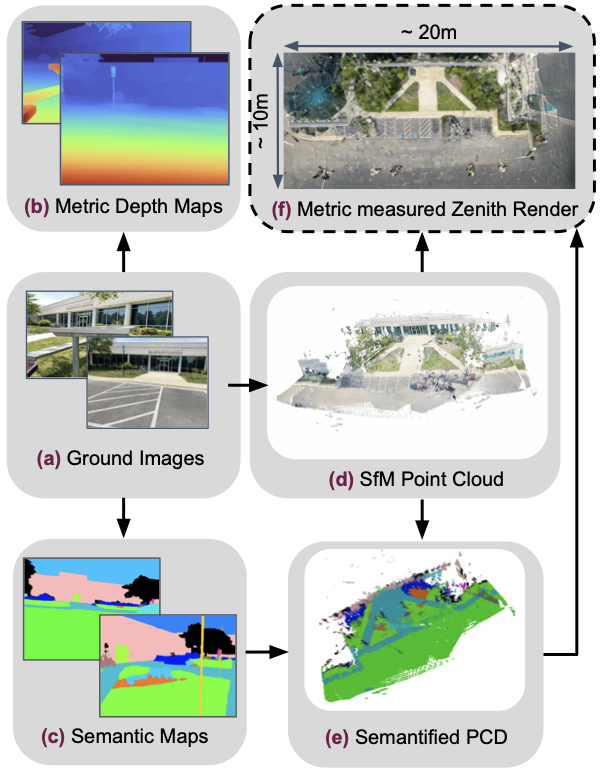
Key intermediate outputs of Wrivinder

Key intermediate outputs. From left to right: semantic segmentation maps, SfM point cloud, semantified 3D reconstruction, monocular metric depth maps, and the resulting metric-scaled zenith render.

MC-Sat Dataset

MC-Sat (Multi-view Capture–Satellite) is the first unified benchmark that jointly links multi-view ground imagery, 3D reconstructions, and geo-registered satellite context across diverse outdoor environments. It fills a critical gap in cross-view geo-localization benchmarks by enabling metrically evaluated, multi-view, and truly zero-shot ground-to-satellite alignment.

MC-Sat dataset visualization

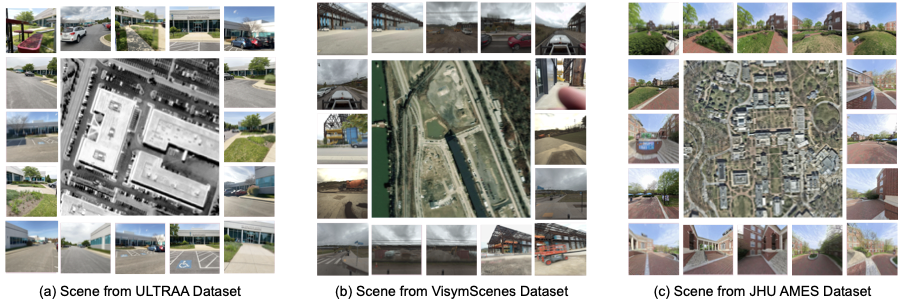
MC-Sat scenes. Ground imagery paired with corresponding geo-registered satellite tiles across diverse outdoor environmentsβ€”campuses, urban areas, and training sites.

Ground Image Sources

Dataset # Scenes # Images Imagery Type
ULTRAA 3 1,028 Ground
VisymScenes 149 258K Ground
ACC-NVS1 6 148K Ground + Airborne
JHU-Ames 1 1,717 Ground + Airborne
Satellite imagery: USDA NAIP (0.6–1.0 m/px, continental US) + ESRI World Imagery (global).

MC-Sat comprises 15 multi-view scenes (∼20K ground images) spanning two complementary scene types: Image Density scenes (many views of a compact region such as a building entrance or courtyard) and Reconstructed Area scenes (campus-scale environments with broad spatial extent). Together they provide a rigorous testbed for both fine-grained and large-area geo-localization.

Results

<30 m
Zero-shot geolocation accuracy (sub-30 m across all scenes)
Zero-shot
No paired ground–satellite training data required
15
Diverse outdoor scenes evaluated on MC-Sat
Satellite–render pairs for several MC-Sat scenes

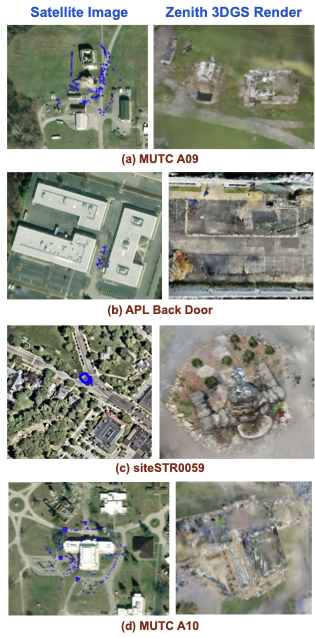
Satellite–render pairs. For each scene, the satellite view (with blue dots marking ground-truth camera locations) is shown alongside the corresponding 3DGS zenith rendering produced by Wrivinder. Gaps and blurring in the reconstruction arise from unobserved surfaces (e.g., rooftops) and are the primary source of higher errors in large-area scenes.

Wrivinder is evaluated using three metrics: Mean Geolocation RMSE (haversine distance between predicted and ground-truth camera coordinates), 67th Percentile RMSE (robust measure less sensitive to outliers), and Centroid Error (large-scale drift indicator). Performance is strongest on dense Image Density scenes; larger Reconstructed Area scenes with unobserved surfaces present an open challenge for future work.

BibTeX

If you find our work useful, please consider citing:

@InProceedings{gudavalli2026wrivinder,
  title     = {wrivinder: Towards Spatial Intelligence for Geo-locating
               Ground Images onto Satellite Imagery},
  author    = {Gudavalli, Chandrakanth and
               Mohammed, Tajuddin Manhar and
               Yadav, Abhay and
               Bhaskar, Ananth Vishnu and
               Prajapati, Hardik and
               Peng, Cheng and
               Chellappa, Rama and
               Chandrasekaran, Shivkumar and
               Manjunath, B. S.},
  booktitle = {Proceedings of the IEEE/CVF Conference on
               Computer Vision and Pattern Recognition (CVPR)},
  year      = {2026},
}

Acknowledgements

This research is supported by the Intelligence Advanced Research Projects Activity (IARPA) via the Department of Interior / Interior Business Center (DOI/IBC) contract number 140D0423C0076. The U.S. Government is authorized to reproduce and distribute reprints for Governmental purposes notwithstanding any copyright annotation thereon. The views and conclusions contained herein are those of the authors and should not be interpreted as necessarily representing the official policies or endorsements, either expressed or implied, of IARPA, DOI/IBC, or the U.S. Government. We would like to thank Jason Bunk for insights and assistance during the initial phase of this project.